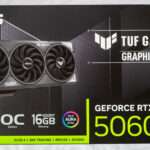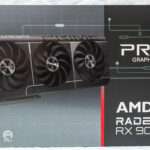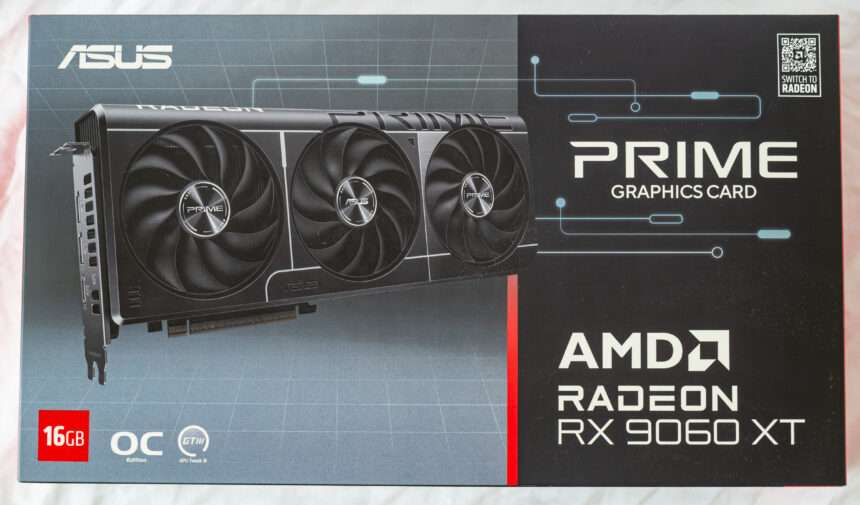
The ASUS Prime Radeon RX 9060 XT OC is AMD’s next-gen mid-range graphics card built on the RDNA 4 architecture. It succeeds the earlier RX 7600 XT generation with notable performance improvements, better power efficiency, and more future-proof features. This card targets gamers seeking excellent 1080p high-FPS performance and solid 1440p gaming without a premium price tag.
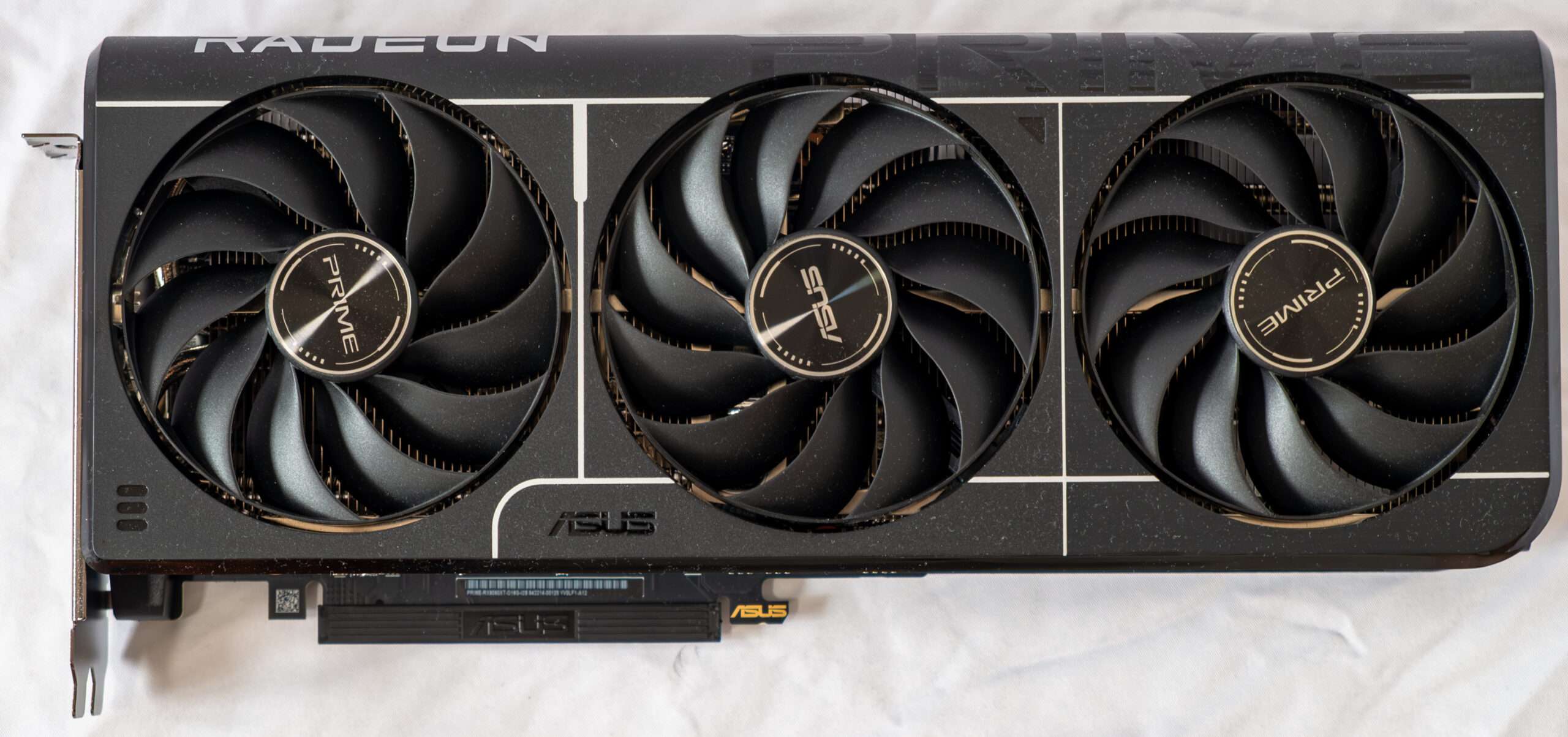
Equipped with 16GB of high-speed GDDR6 memory, the RX 9060 XT ensures smooth gameplay at 1080p resolution, efficient handling of complex 3D workloads, and reliable multitasking for demanding applications. ASUS enhances this foundation with its Prime series engineering, emphasizing stability, cooling efficiency, and durability. The card features a robust triple-fan cooling solution, reinforced backplate, and factory overclock settings that keep performance consistent under heavy load.
| AMD Radeon RX 9070 XT Specs | |
| Feature | ASUS Prime Radeon RX9060 XT 16GB GDDR6 OC |
| Architecture | RDNA™ 4 |
| Manufacturing Process | TSMC N4P |
| Transistor Count | 29,8700 millions |
| Die Size | 199 mm² |
| Compute Units | 32 |
| Ray Accelerators | 32 |
| AI Accelerators | 54 |
| Stream Processors | 2048 |
| Game GPU Clock | 2520 MHz |
| Boost GPU Clock | Up to 3060 MHz |
| ROP | 64 |
| AMD Infinity Cache™ | 32 MB (3rd Gen.) |
| Memory | 16GB GDDR6 |
| Memory Speed | 20 Gbps |
| Memory Bus Interface | 128-bits |
| PCIe® Interface | PCIe 5.0 x16 |
| Recommended PSU | 550 W |
AMD RDNA 4 Architecture
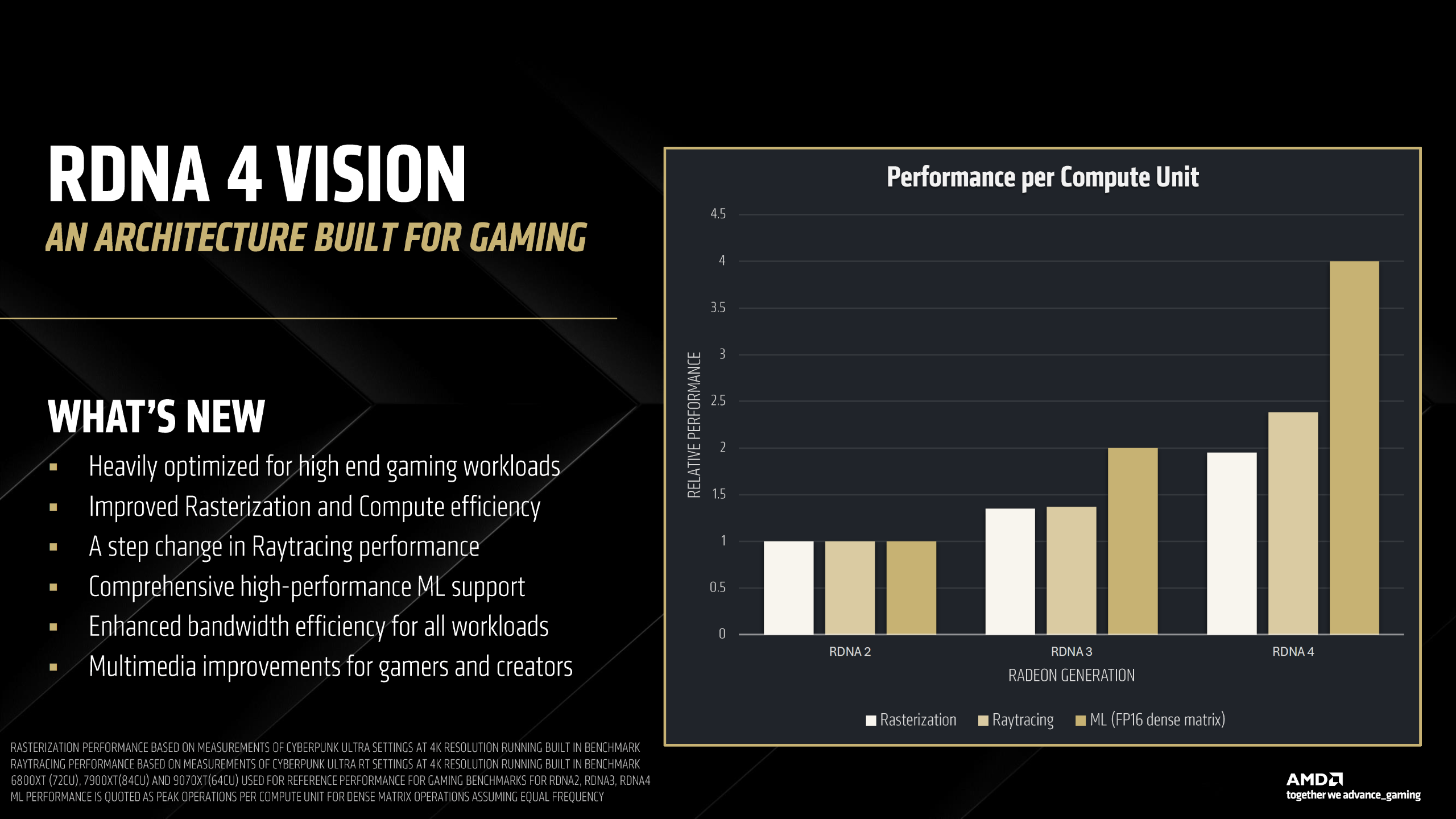
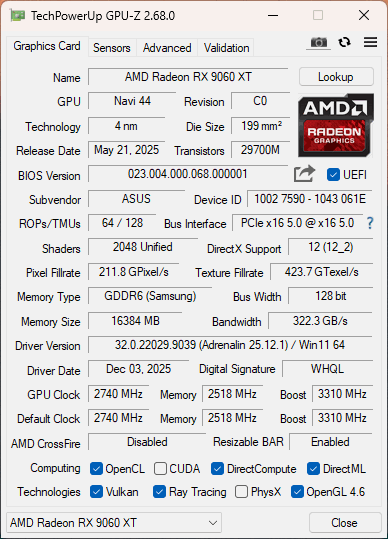
The new Radeon RX 9060XT and RX9060 are powered by the 4 nm Navi 44 silicon and features exactly half the compute unit count of the Navi 48 chip used in the RX 9070 XT. It is equipped with 32 compute units, translating to 2,048 stream processors, alongside 64 AI accelerators, 32 ray-tracing accelerators, 128 texture mapping units (TMUs), and 64 render output units (ROPs).
Memory-wise, the card carries 16 GB of GDDR6 connected via a 128-bit memory bus. Retaining the older GDDR6 standard, AMD clocks the memory at 20 Gbps, delivering a total bandwidth of 320 GB/s—an approximate 11% improvement over its predecessor. This comes at a time when NVIDIA has transitioned to faster 28 Gbps GDDR7 memory for its competing RTX 5060 and 5060 Ti GPUs. AMD, however, claims that architectural improvements in memory handling effectively offset the relatively modest increase in raw bandwidth.
The Navi 44 GPU also integrates 32 MB of Infinity Cache, helping to reduce memory latency and improve effective bandwidth. A notable generational improvement is the adoption of a full PCI Express 5.0 x16 interface, a significant upgrade over the PCIe 4.0 x8 configuration used on the RX 7600 and RX 6600 series. This change results in a fourfold increase in host interface bandwidth, enhancing compatibility and performance on modern platforms.
Physically, the Navi 48 silicon consists of 64 CU spread across four shader engines. Each CU houses 64 stream processors, resulting in a total of 4,096 stream processors. The RX 9070 XT has all 64 CU enabled, whereas the RX 9070 has 56 active CU out of 64. The fully unlocked Navi 48 features 4,096 stream processors, 128 AI accelerators, 64 ray tracing accelerators, 256 texture mapping units (TMUs), and 128 render output units (ROPs). It also includes 64 MB of third-generation Infinity Cache and a 256-bit GDDR6 memory interface, driving 16 GB of 20 Gbps memory on both the RX 9070 XT and RX 9070. With 56 CU enabled, the RX 9070 has 3,584 stream processors, 112 AI accelerators, 56 RT accelerators, 224 TMUs, and retains the full 128 ROP count, along with the same memory configuration as the RX 9070 XT.
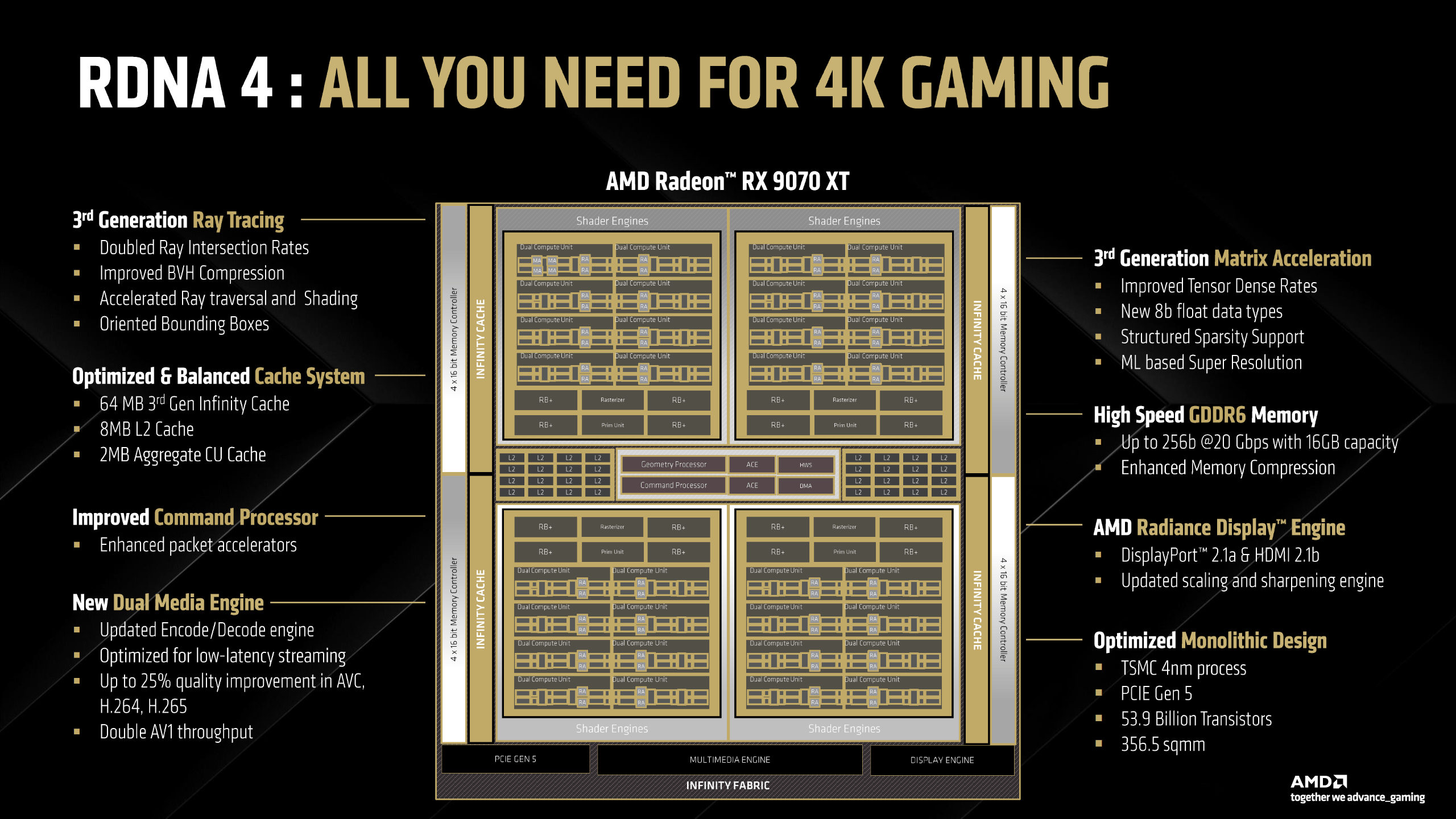
At the core of the RDNA 4 graphics architecture is the newly designed dual compute unit (CU), featuring significant advancements in memory management, scalar unit efficiency, and engine clock optimizations. Key innovations include a vastly improved memory sub-system, dynamic register allocation, and enhancements to CU efficiency.
Each CU consists of two scheduler blocks controlling a 192 KB general-purpose register (GPR), an 8 KB scalar GPR, 32 fused multiply-add (FMA) ALUs, and 32 FMA+INT ALUs, along with 8 transcendental logic units. RDNA 4 introduces dual SIMD32 vector units, enabling greater parallelism. The scalar unit now supports newer Float32 operations, while schedulers benefit from accelerated spill/fill operations and improved instruction prefetching.
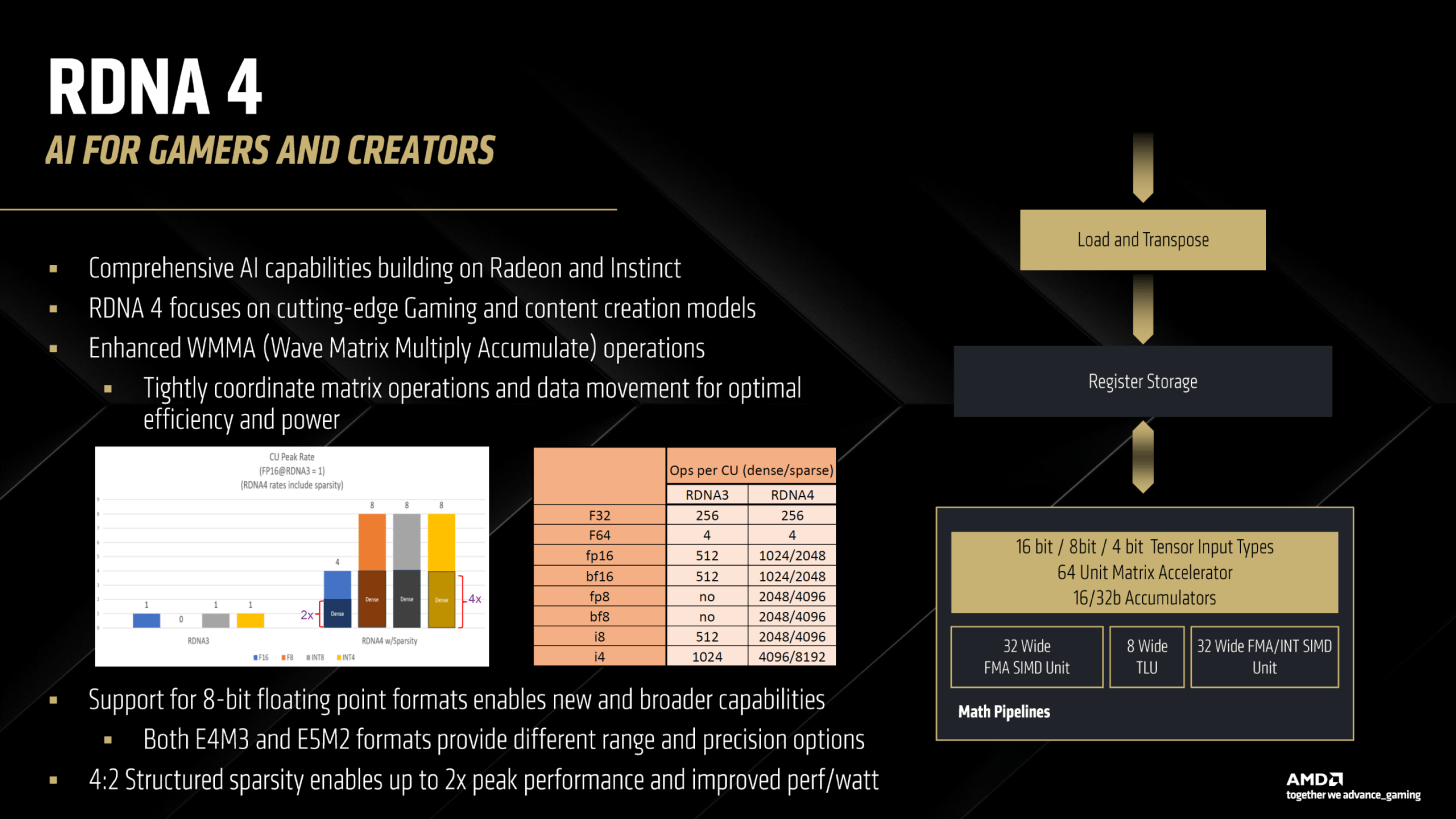
The new generation AI Accelerator integrates two 16-bit and four 8-bit/4-bit dense matrix compute rates, supports 4:2 structured sparsity to double throughput, and enables matrix loads with transpose. AMD has incorporated multiple technologies from its CDNA 3 Radeon Instinct AI ML accelerators, including enhanced and power-optimized WMMA, increased operations per CU, and support for FP8, E4M3, and E5M2 formats, alongside 4:2 structured sparsity improvements.
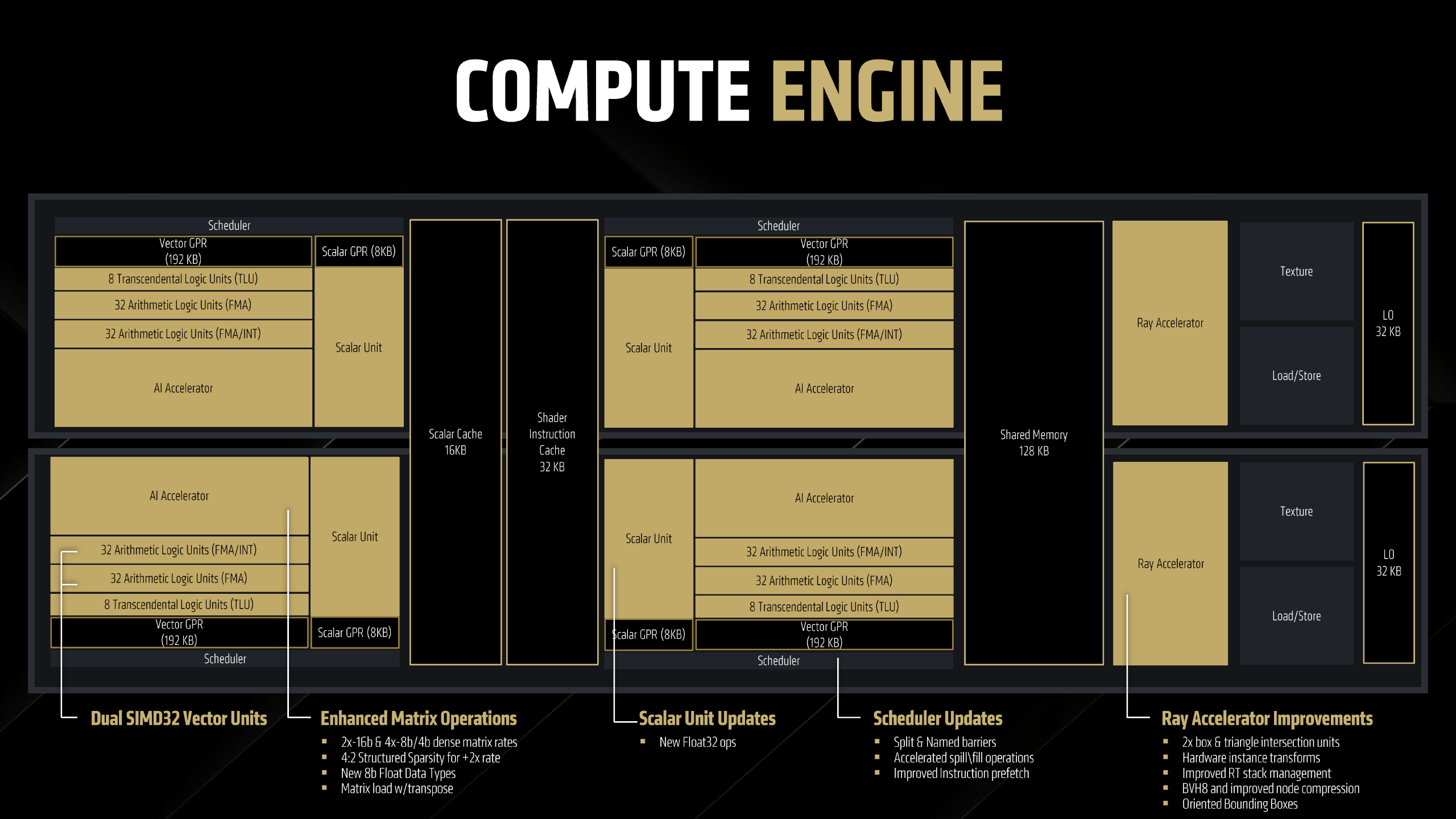
The next-generation AI Accelerator in RDNA 4 features two 16-bit and four 8-bit/4-bit dense matrix compute rates, along with support for 4:2 structured sparsity, effectively doubling throughput. It also introduces matrix loads with transpose for enhanced efficiency. AMD has integrated several advanced technologies from its CDNA 3 Radeon Instinct AI ML accelerators into RDNA 4’s AI engines, including optimized and power-efficient WMMA, increased operations per CU, and expanded support for FP8, E4M3, and E5M2 formats, alongside 4:2 structured sparsity enhancements.
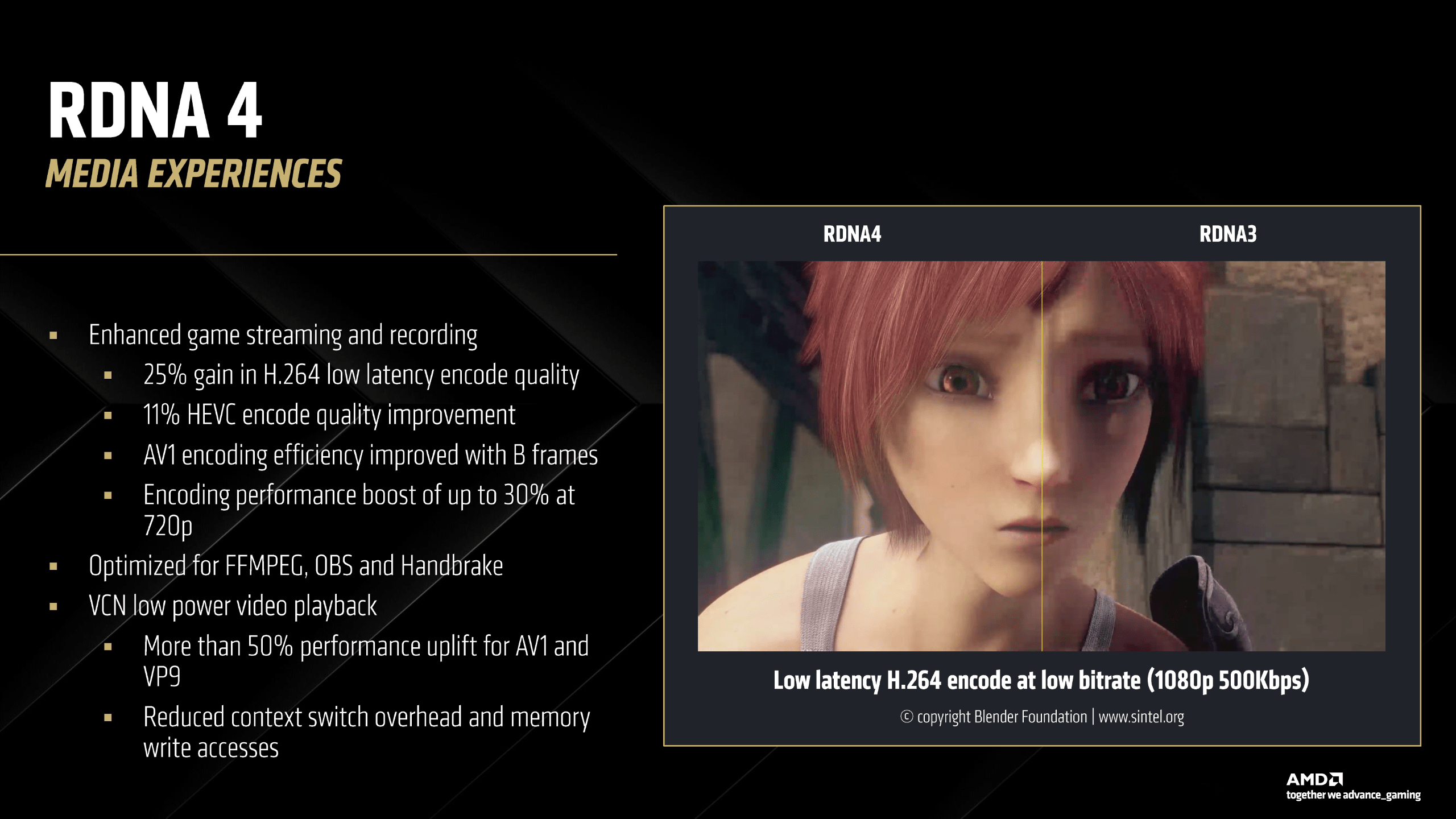
The Navi 48 features a dual media engine, with each engine capable of performing concurrent encoding and decoding. This implementation is similar to NVIDIA GPUs, which have dual NVENC and NVDEC units. The new-generation media engine delivers a 25% improvement in H.264 low-latency encode quality and an 11% boost in HEVC encode quality. Additionally, AV1 encode and decode now support B-frames, significantly enhancing bitrate efficiency. Overall, the media engine offers a 50% generational performance uplift in encoder/decoder frame rates, while also reducing memory overhead.
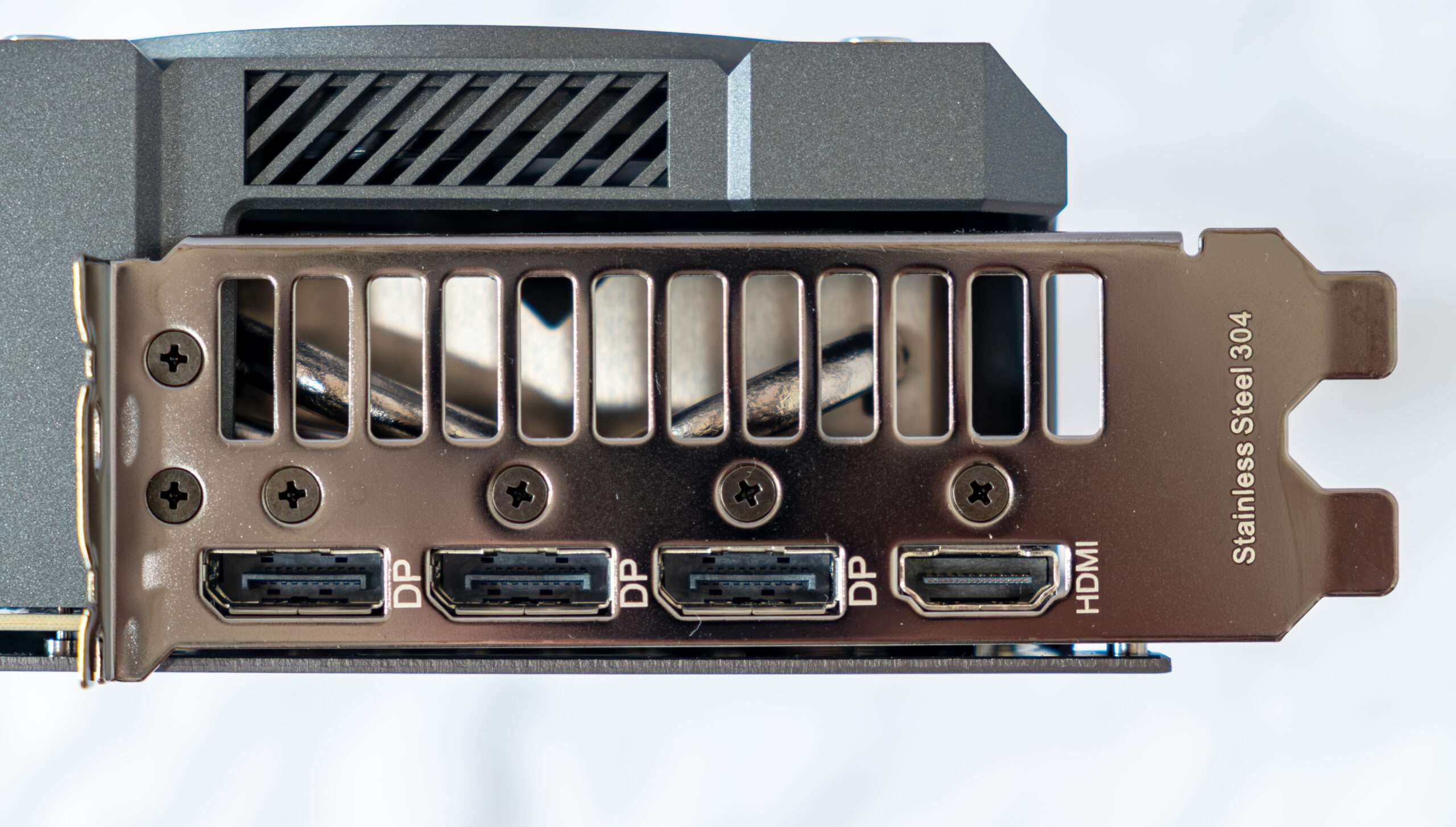
With modern connectivity options including HDMI 2.1 and DisplayPort 2.1, the ASUS Prime Radeon RX 9060 XT is ready for high-refresh-rate monitors and multi-display setups. Whether you’re building a powerful gaming rig or a content creation workstation, this card offers a balanced mix of performance, reliability, and future-ready technology.
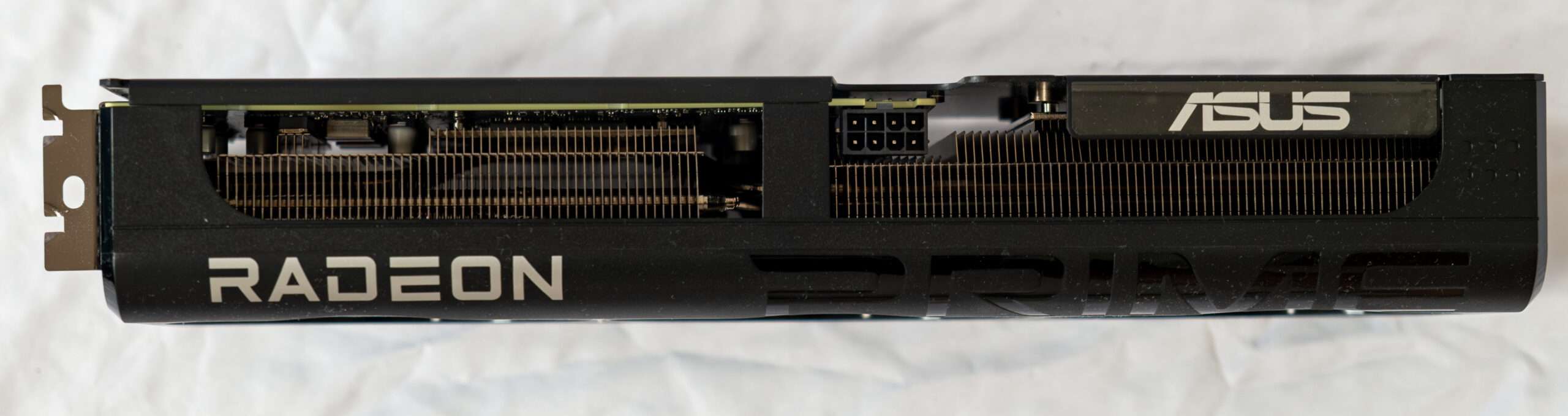
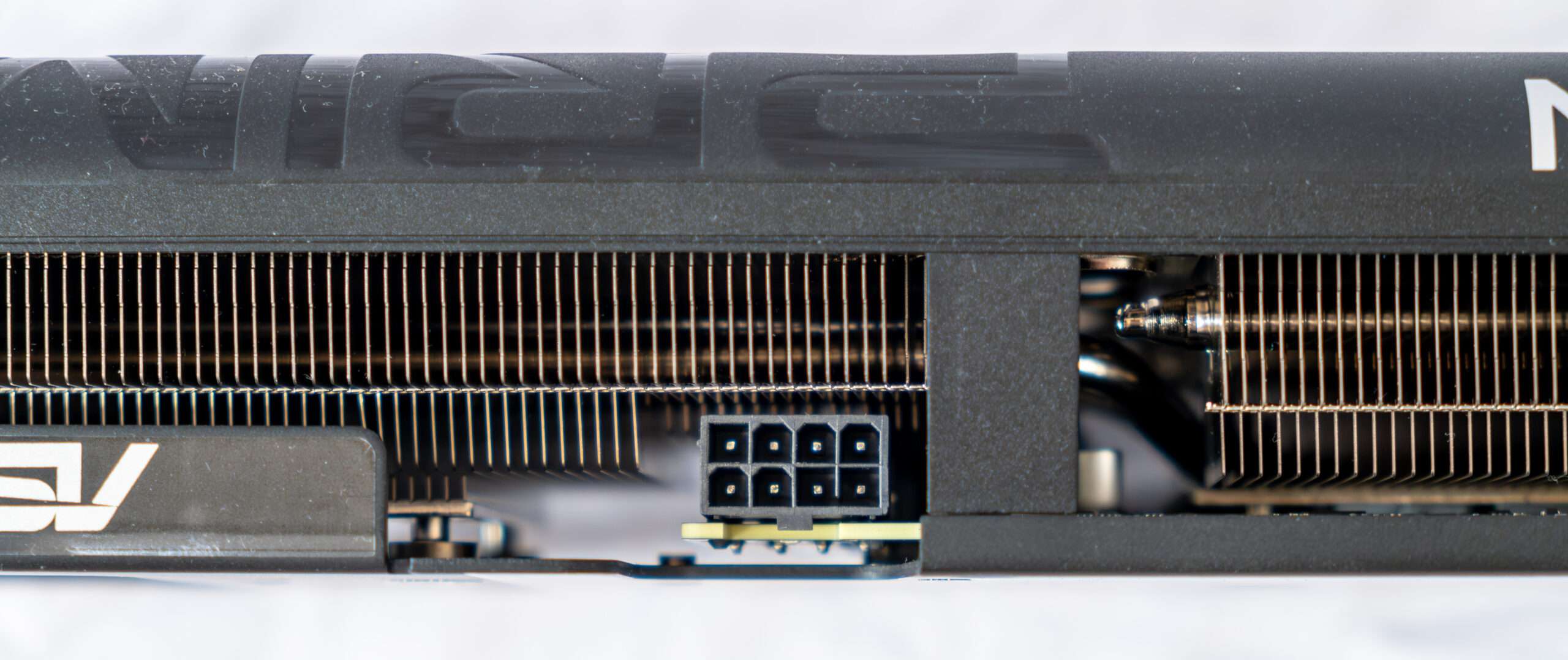
It’s uses a standard 8-pin PCIe power connector for additional power input beyond the PCIe slot.
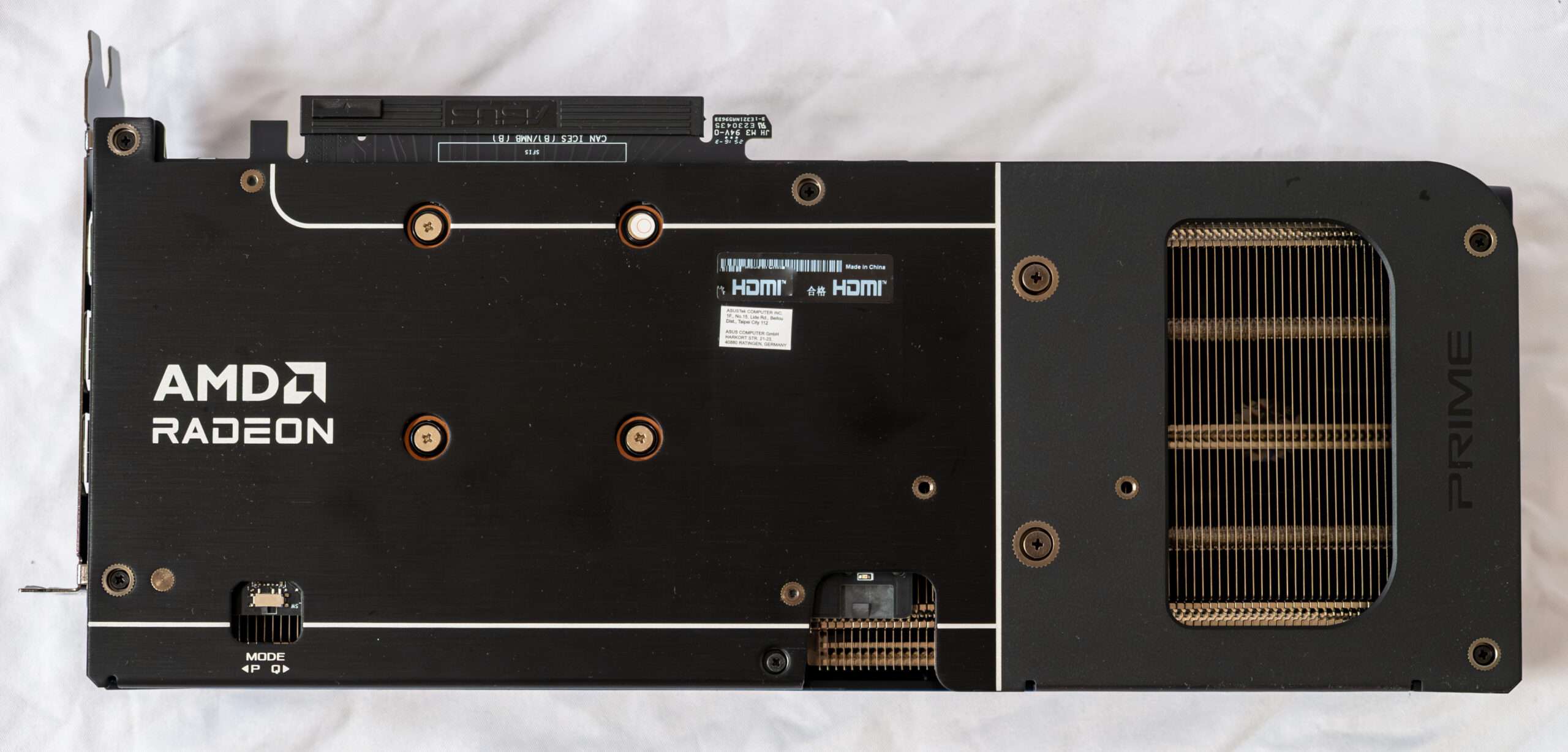
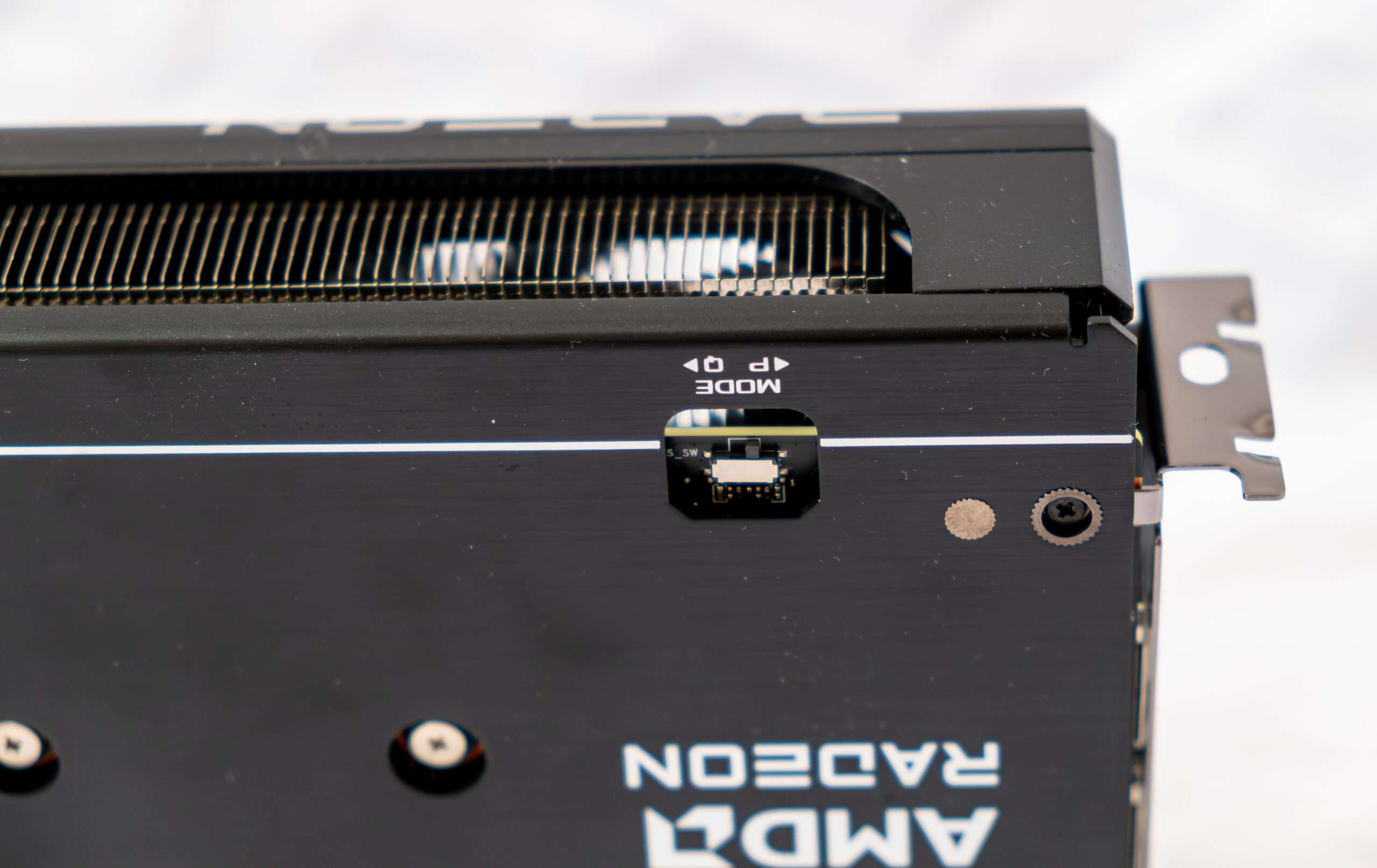
A dual BIOS switch, allowing users to toggle between two BIOS profiles. This switch typically lets you choose between a performance-optimized BIOS and a quieter, more power-efficient BIOS mode, giving flexibility depending on your usage or cooling preferences.
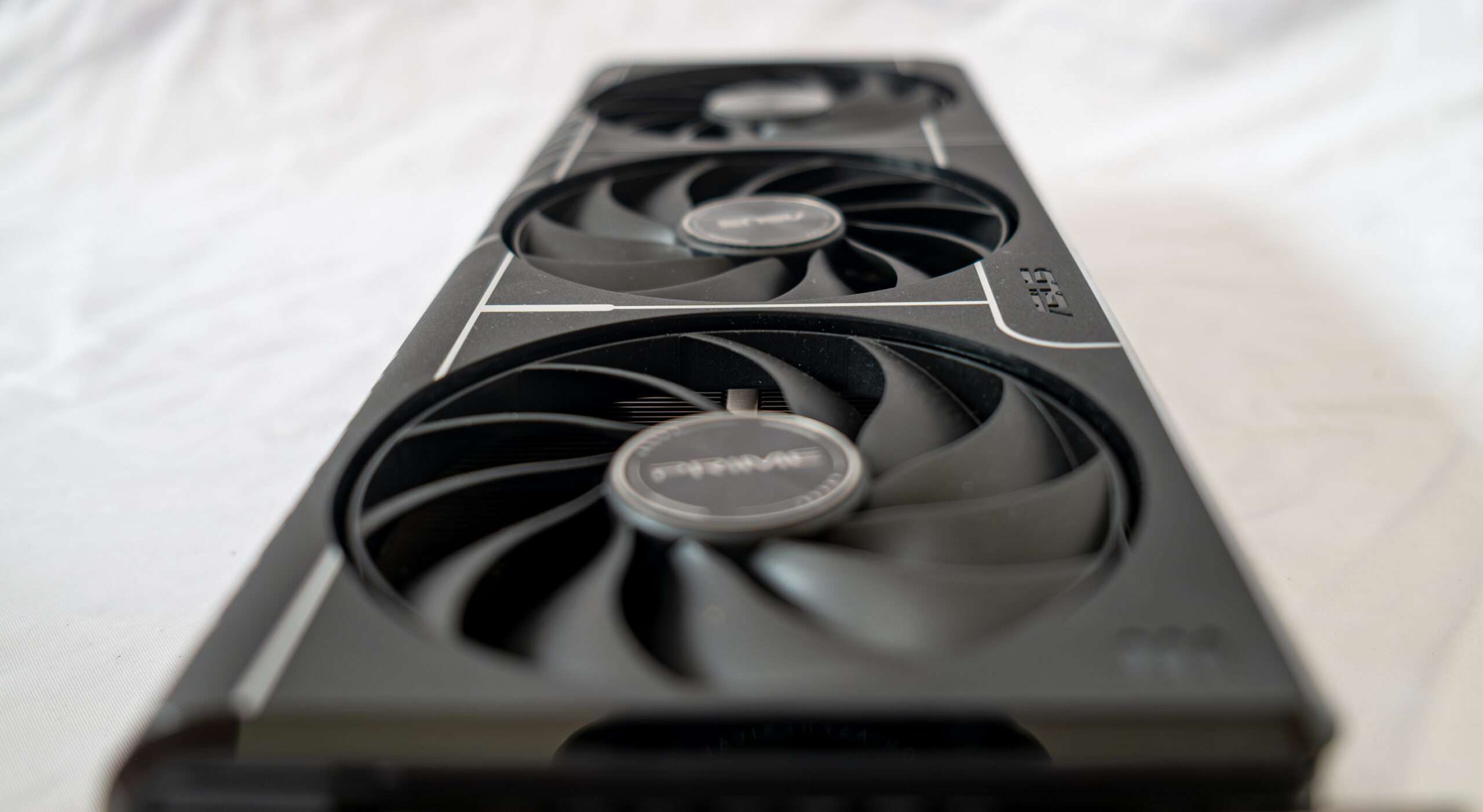
It’s features a robust triple-fan cooling system with three axial-tech fans designed to maximize airflow while minimizing noise. This setup ensures efficient heat dissipation even during intense gaming sessions or heavy workloads, helping maintain optimal performance and quieter operation.
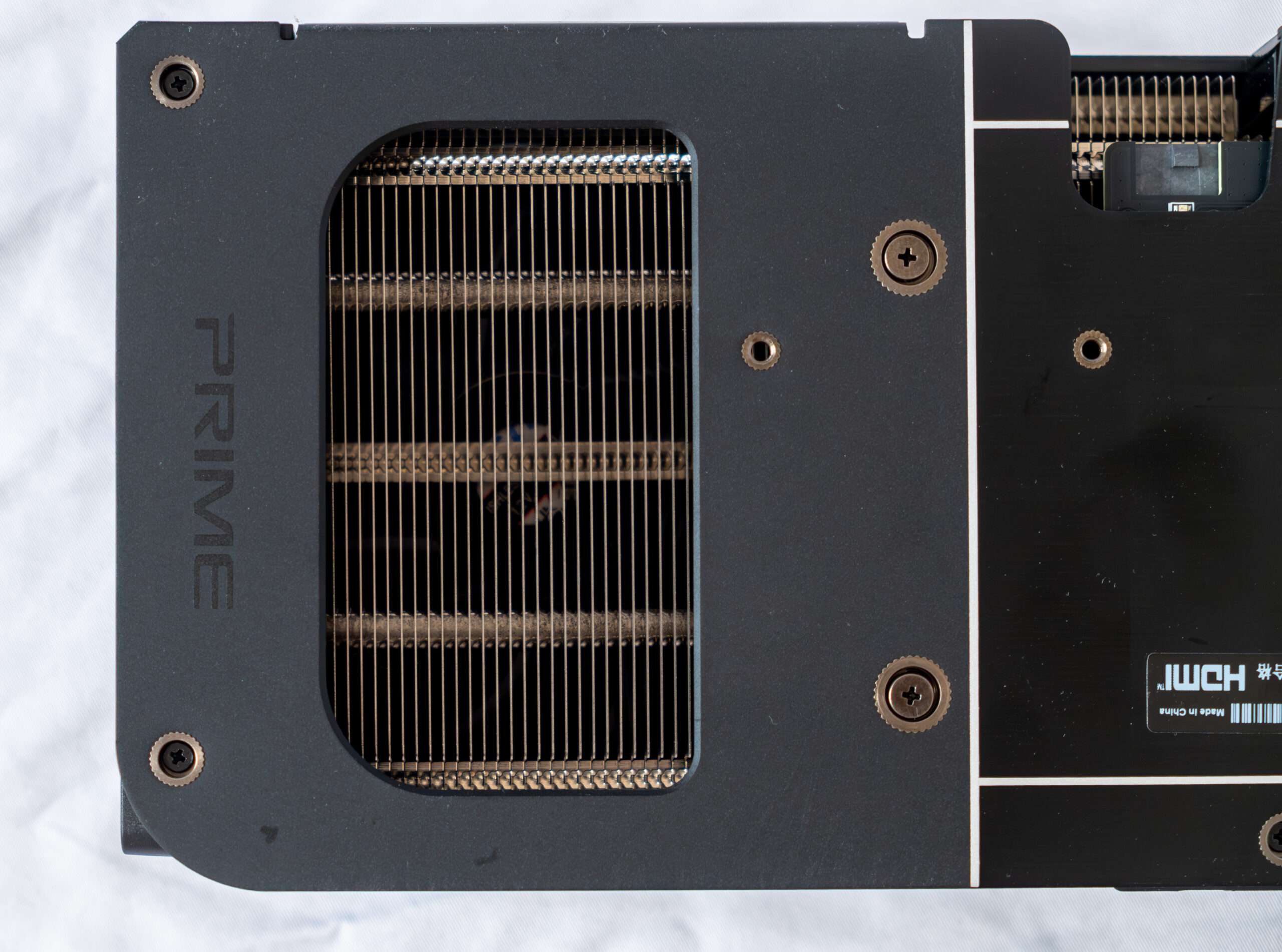
The vented backplate that actively helps push heat away from the GPU. This design improves overall thermal management by allowing hot air to escape more efficiently
How We Test ASUS Radeon Prime RX 9060XT 16G OC?
As such, our workstation, based on an TUF Z890-Plus WIFI motherboard and Intel Ultra 9 285K 24 cores 24 threads processor. The ram we will be using KLEVV DDR5 7200Mhz memory kit and Lexar 790 PCIe 4.0 1TB SSD is used as well to run with benchmark. On the Comparison, we will be using same setup with RX 9070XT, RTX 5070Ti and ROG RTX4080OC to run side by side to see perform better.
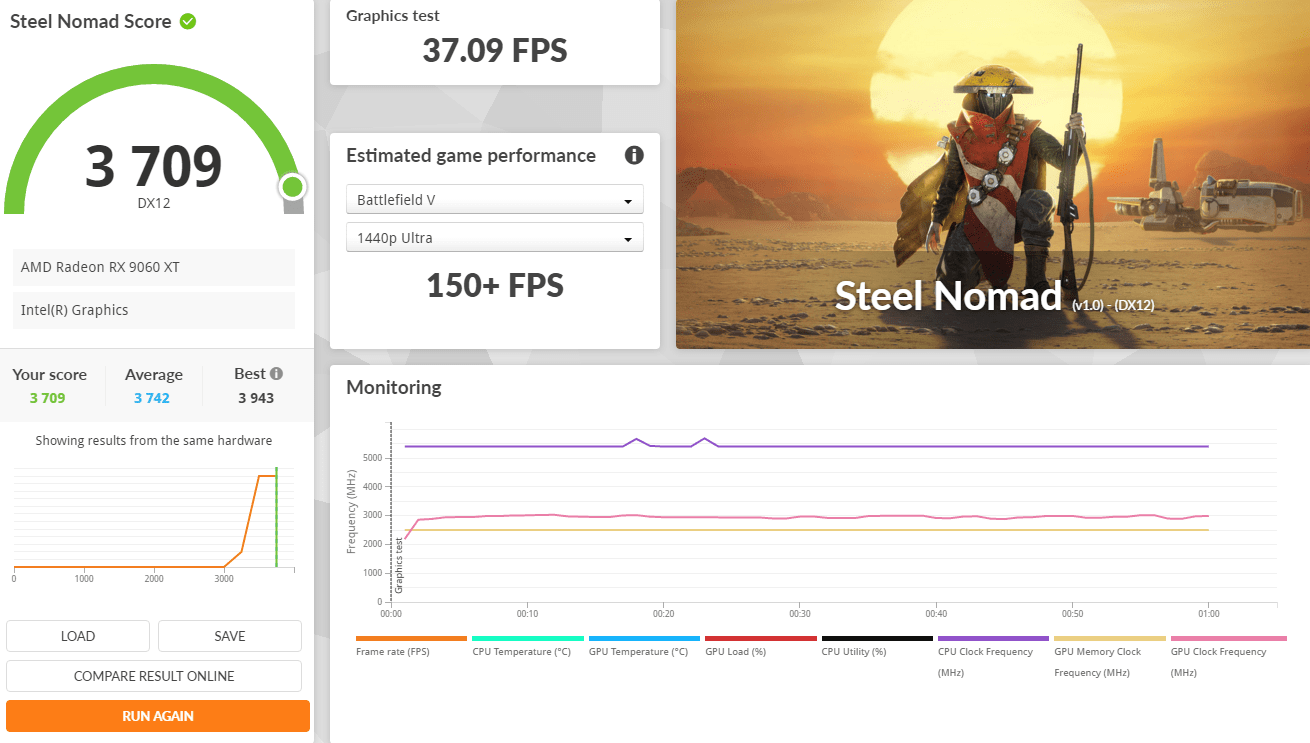
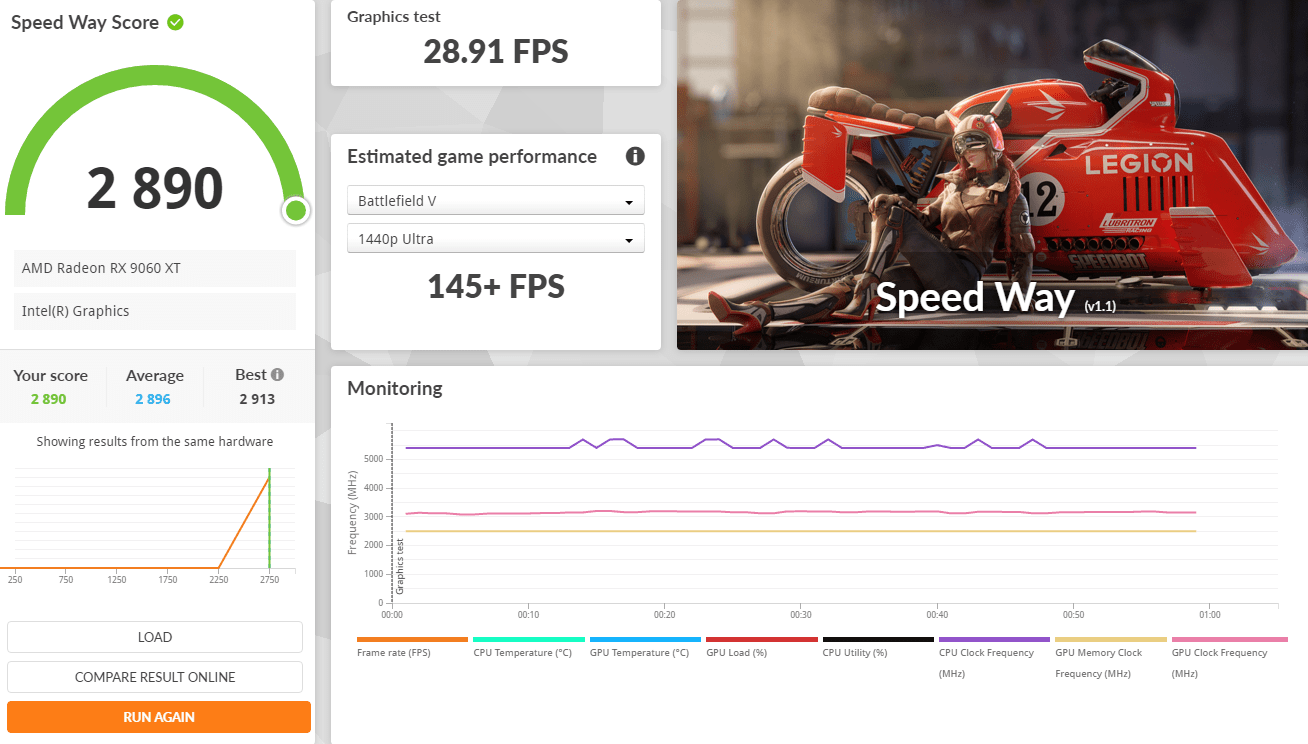
3Dmark Advanced Edition
3DMark includes everything you need to benchmark your PC and mobile devices in one app. Whether you’re gaming on a smartphone, tablet, notebook, or a desktop gaming PC, 3DMark includes a benchmark designed specifically for your hardware.
| Benchmark | ASUS TUF RX9060XT 16GB OC | Gigabyte RX9070XT Gaming ELITE | ASUS ROG RTX4080OC | ASUS TUF RTX 5060TI 16GB OC |
| Fire Strike Ultra | 9637 | 18278 | 17939 | 9947 |
| Time Spy Extreme | 7961 | 14791 | 14146 | 8076 |
| Solar Bay Extreme | 10478 | 122009 | 139980 | 15501 |
| Port Royal | 9626 | 18791 | 18380 | 10377 |
| Steel Nomad | 3709 | 7223 | 6743 | 3584 |
| Speed Way | 2890 | 6364 | 7480 | 4192 |
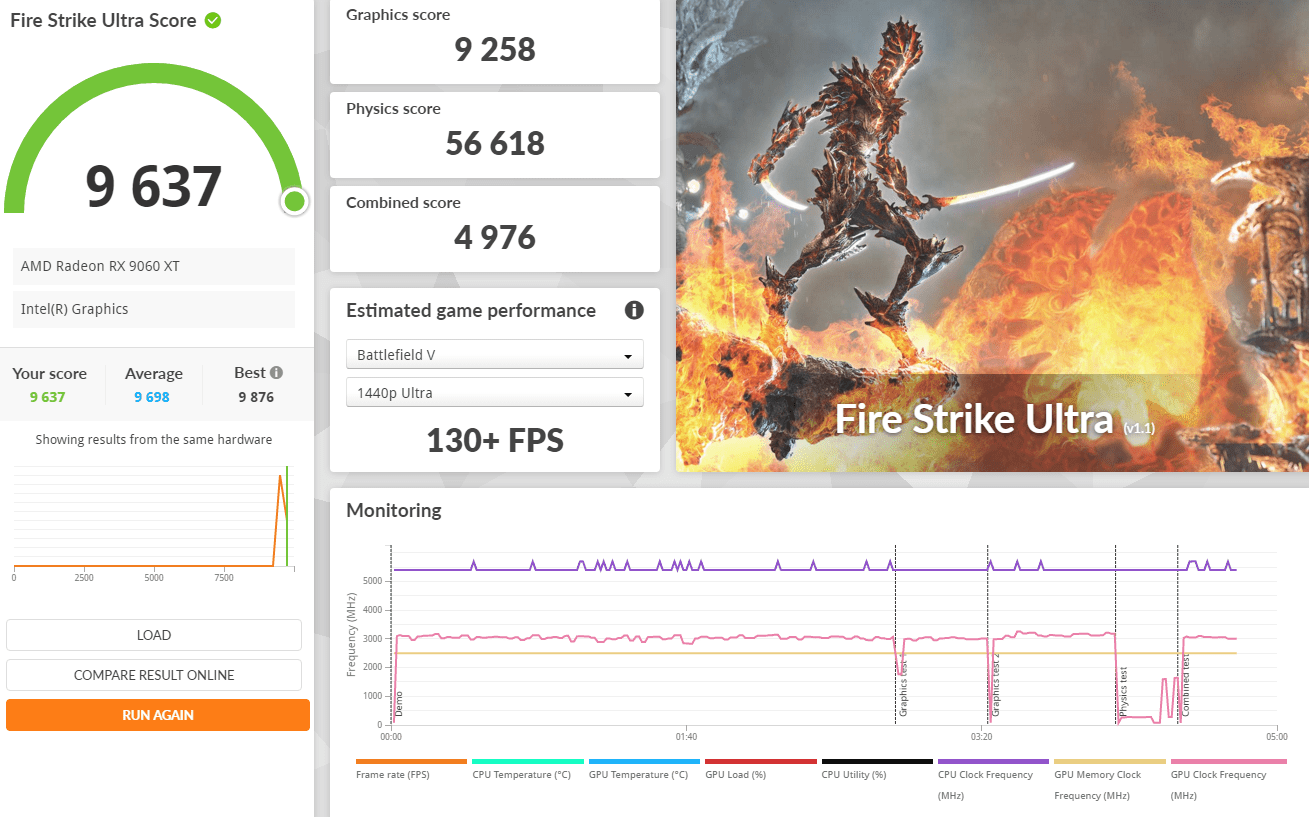
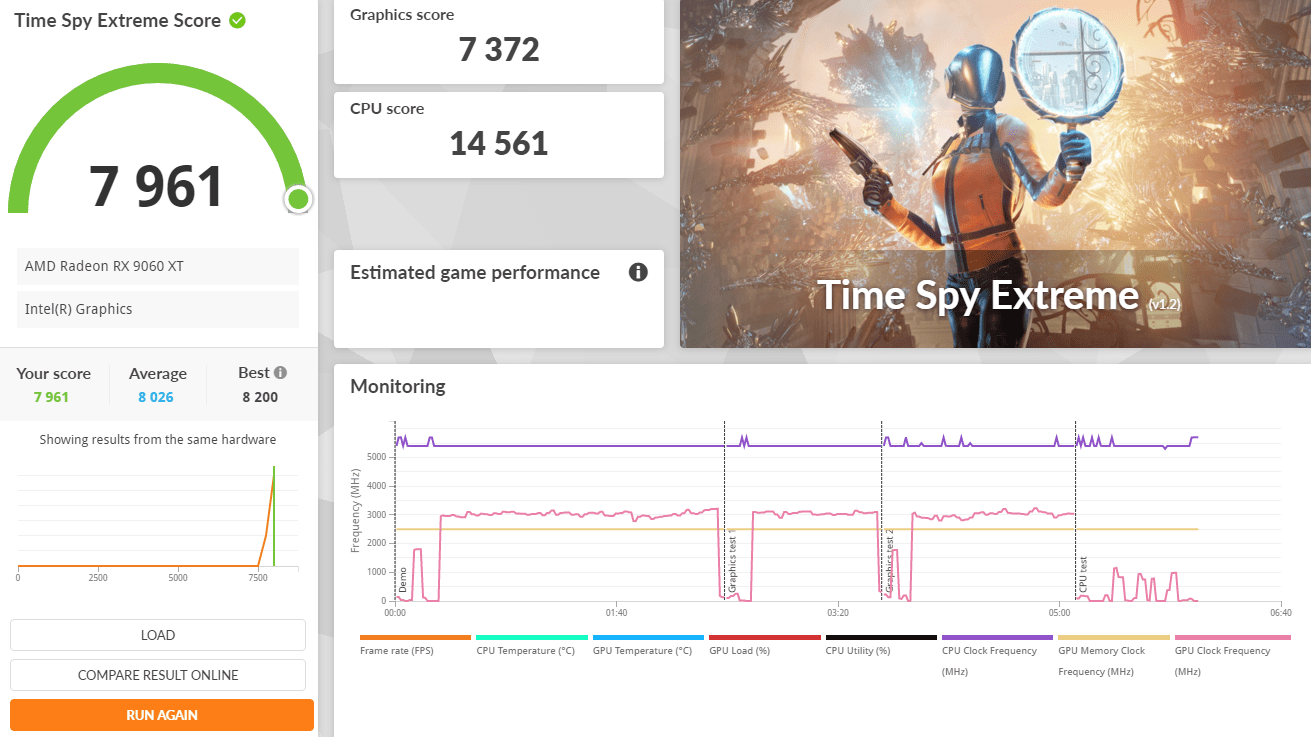
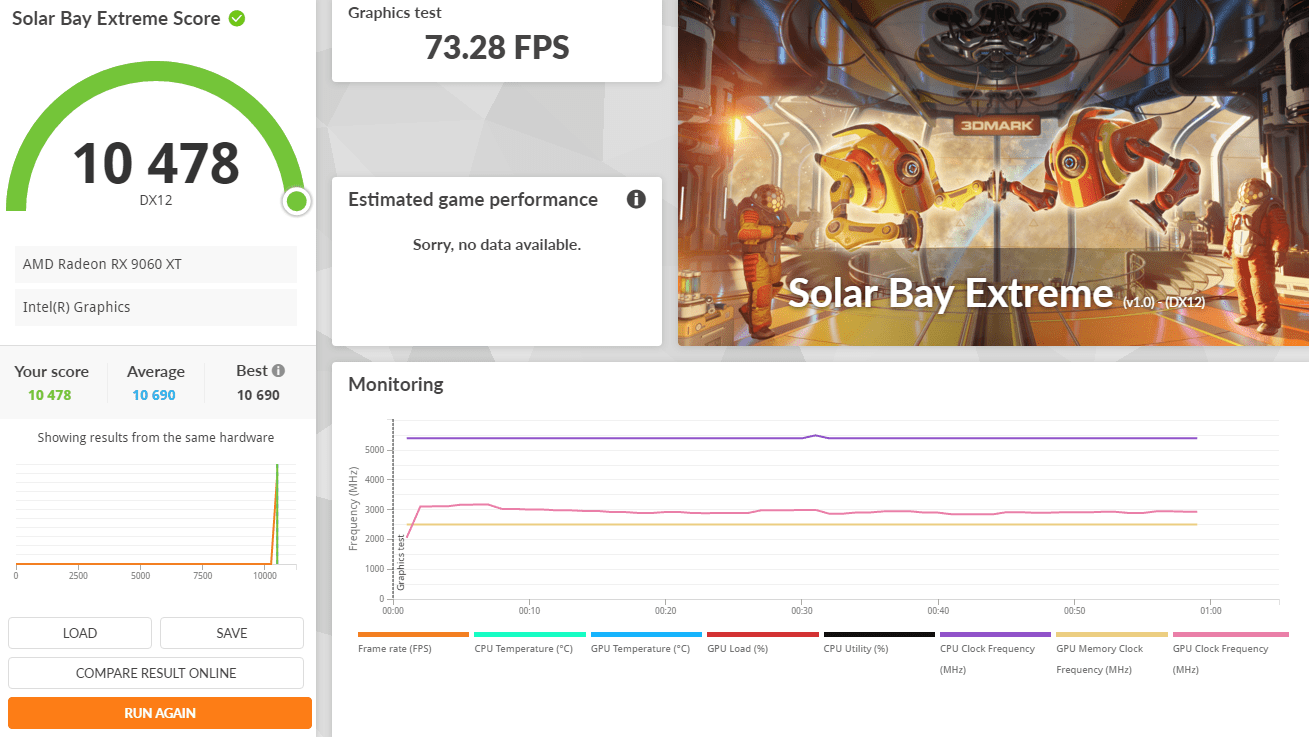
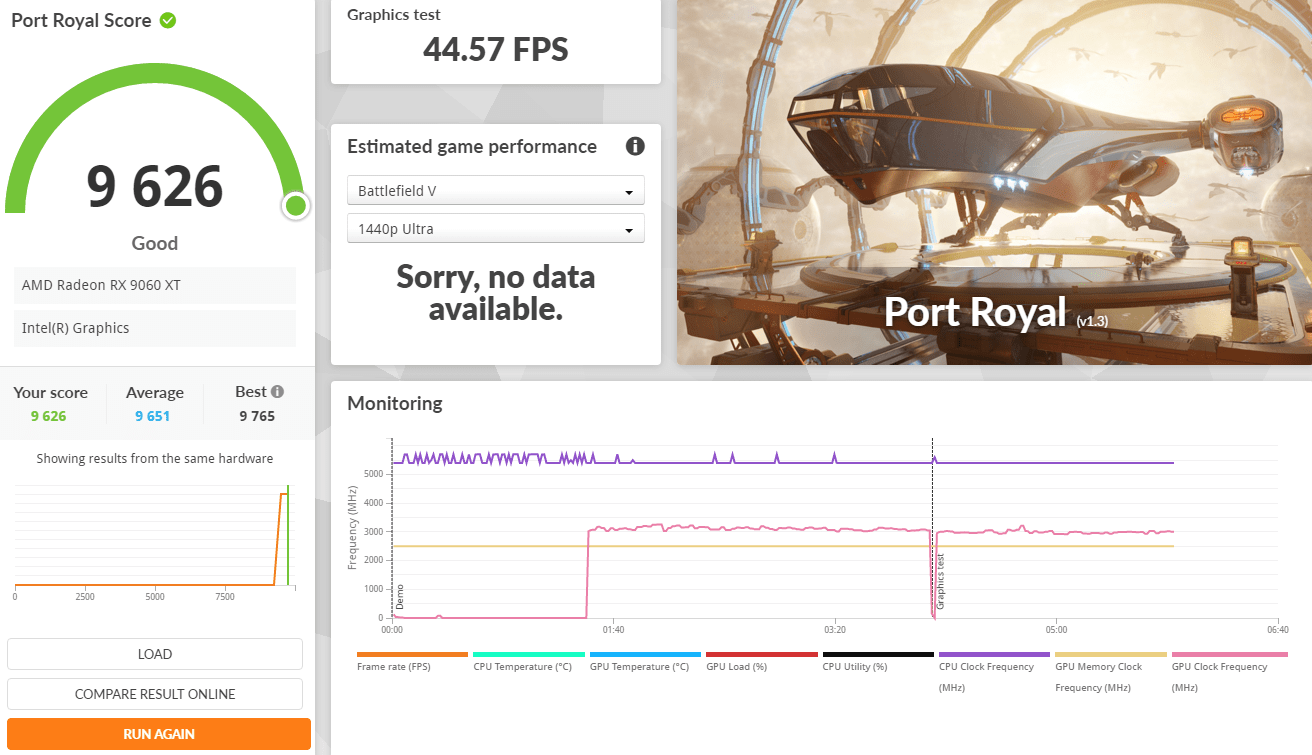
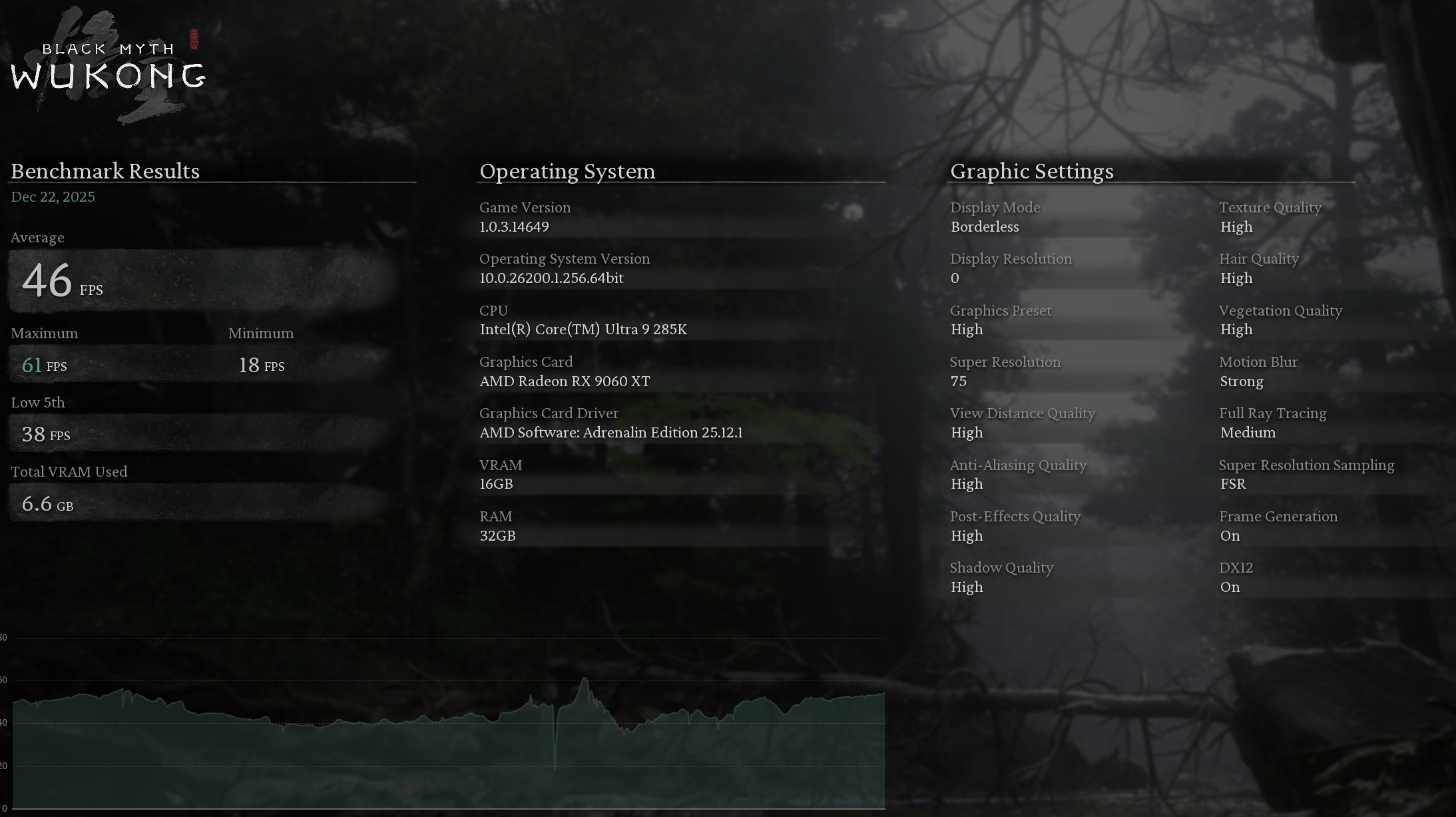
“Black Myth: Wukong”. It evaluates your hardware performance and system compatibility through the real-time rendering of an in-game sequence
| Benchmark | ASUS TUF RX9060XT 16GB OC | Gigabyte RX9070XT Gaming ELITE | ASUS ROG RTX4080OC | ASUS TUF RTX 5060TI 16GB OC |
| Average FPS | 46 | 42 | 81 | 68 |
| Maximum FPS | 61 | 54 | 95 | 80 |
| Minimum FPS | 18 | 32 | 66 | 60 |
| Low 5th FPS | 38 | 36 | 70 | 62 |
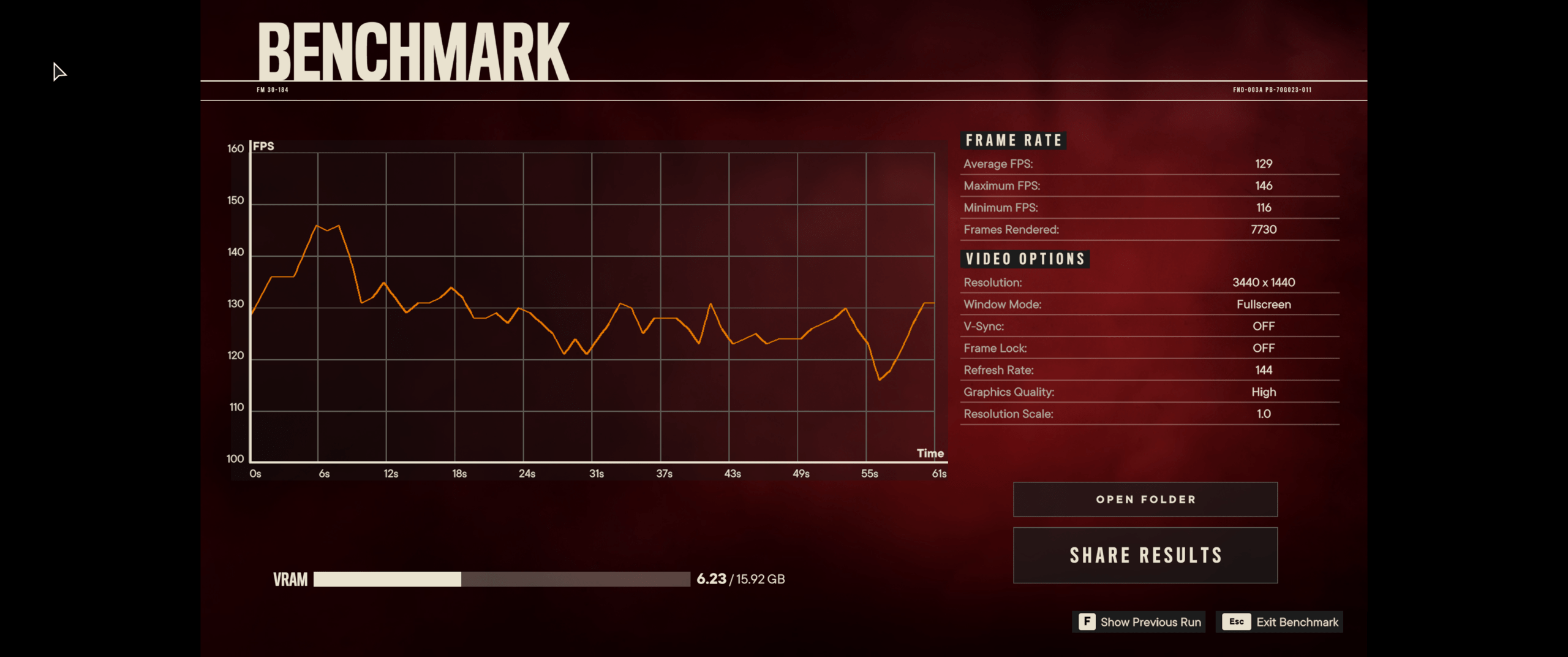
FarCry 6
Far Cry 6 supports ray tracing at launch, with the ability to enable DXR reflections and DXR shadows. But because DXR shadows are kind of pointless and not worth the performance hit, we haven’t tested with them enabled, but I have taken a look at DXR reflections, so we’ll look at that shortly using supported hardware.
| Benchmark | ASUS TUF RX9060XT 16GB OC | Gigabyte RX9070XT Gaming ELITE | ASUS ROG RTX4080OC | ASUS TUF RTX 5060TI 16GB OC |
| Average FPS | 129 | 143 | 125 | 125 |
| Maximum FPS | 146 | 219 | 150 | 140 |
| Minimum FPS | 116 | 117 | 103 | 109 |
| Frames Rendered | 7730 | 8606 | 7603 | 7620 |
Ghost Recon Breakpoint
Ghost Recon Breakpoint is a military shooter set in a diverse, hostile, and mysterious open world that you can play entirely solo or in four-player co-op.
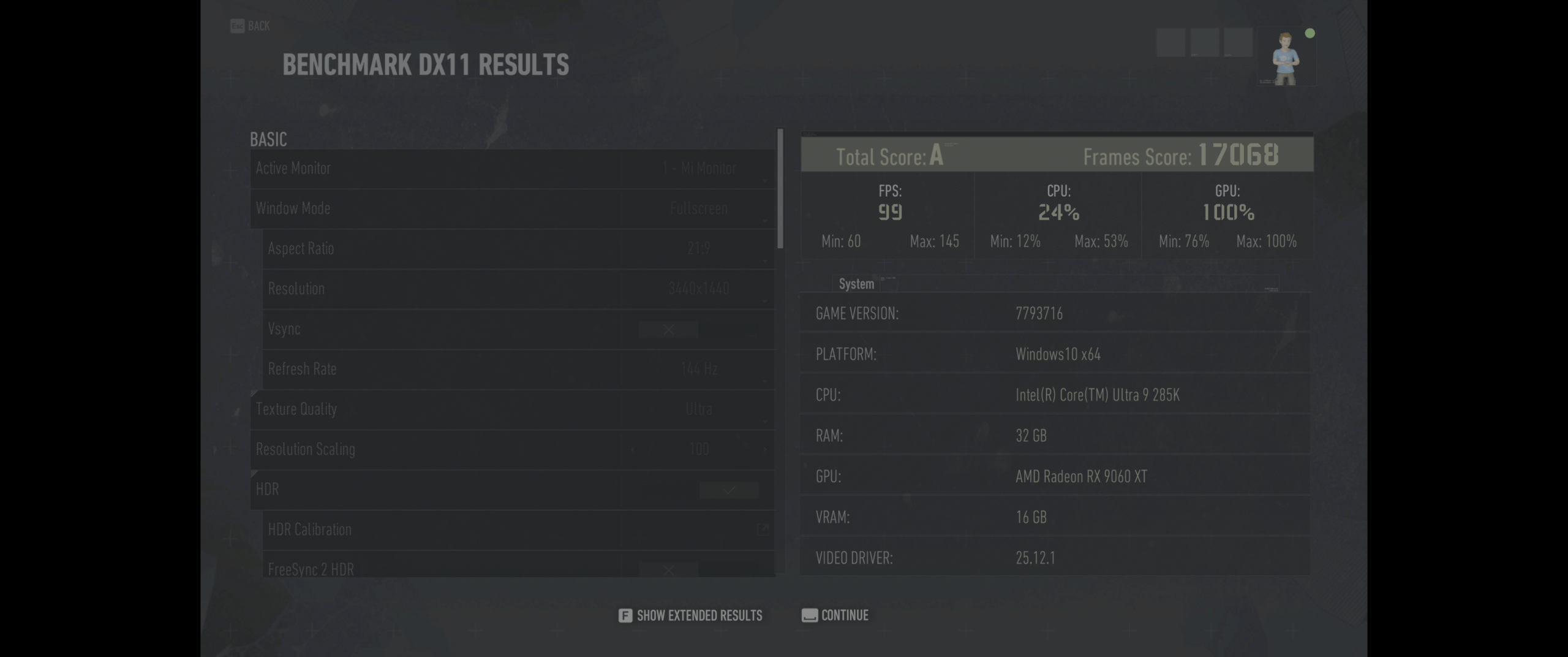
| Benchmark | ASUS TUF RX9060XT 16GB OC | Gigabyte RX9070XT Gaming ELITE | ASUS ROG RTX4080OC | ASUS TUF RTX 5060TI 16GB OC |
| Score | A | S | S | A |
| FPS | 99 | 168 | 150 | 75 |
| Frames Score | 17068 | 28907 | 25953 | 12944 |
Final Fantasy XIV: Dawntrail
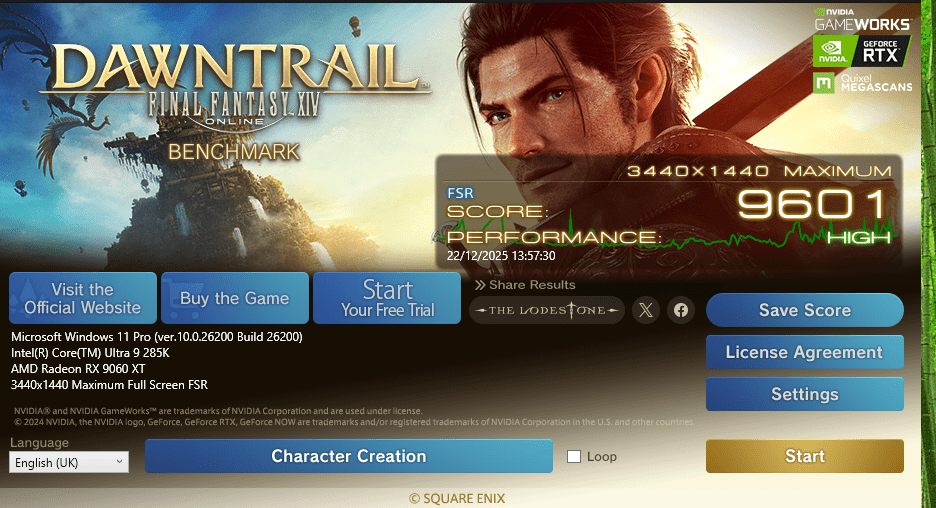
| Benchmark | ASUS TUF RX9060XT 16GB OC | Gigabyte RX9070XT Gaming ELITE | ASUS ROG RTX4080OC | ASUS TUF RTX 5060TI 16GB OC |
| Score | 9601 | 18518 | 22129 | 12058 |
SuperPosition 2017
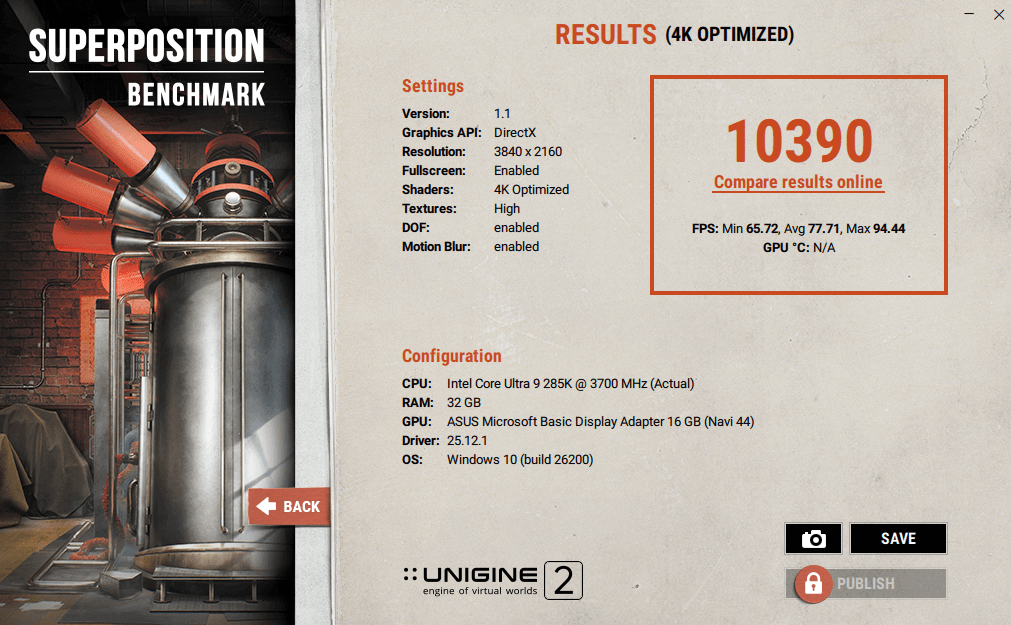
Extreme performance and stability test for PC hardware: video card, power supply, cooling system. Check your rig in stock and overclocking modes with real-life load! Also includes interactive experience in a beautiful, detailed environment.
| Benchmark | ASUS TUF RX9060XT 16GB OC | Gigabyte RX9070XT Gaming ELITE | ASUS ROG RTX4080OC | ASUS TUF RTX 5060TI 16GB OC |
| Score | 10390 | 18608 | 22634 | 12250 |
BaseMark GPU
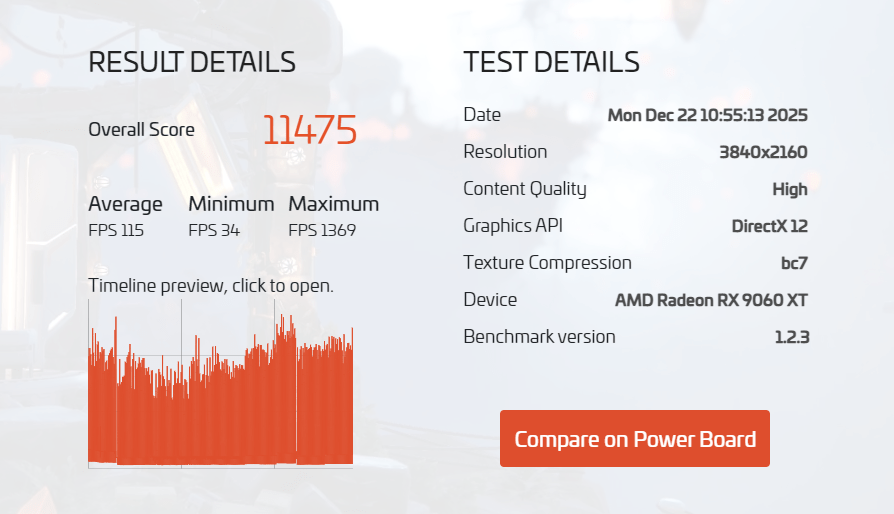
Basemark GPU is a professional assessment tool, enabling the evaluation and comparison of graphics performance on both mobile and desktop platforms, while supporting all major graphics APIs and operating systems. Consumers can evaluate their device performance for free with Basemark GPU and review and compare results online in the integrated PowerBoard
| Benchmark | ASUS TUF RX9060XT 16GB OC | Gigabyte RX9070XT Gaming ELITE | ASUS ROG RTX4080OC | ASUS TUF RTX 5060TI 16GB OC |
| Average FPS | 115 | 83 | 114 | 154 |
| Minimum FPS | 34 | 72 | 95 | 112 |
| Maximum FPS | 1369 | 104 | 139 | Error |
| Score | 11475 | 8281 | 11381 | 15407 |
GeekBench
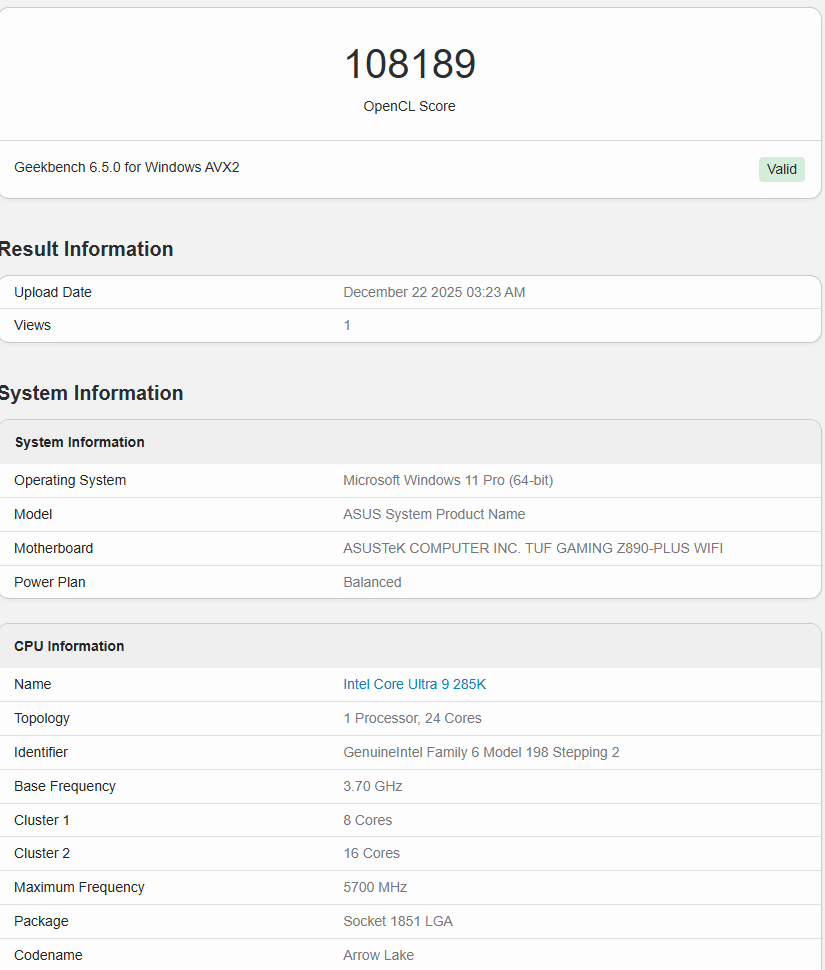
Geekbench AI is a cross-platform AI benchmark that uses real-world machine learning tasks to evaluate AI workload performance. Geekbench AI measures your CPU, GPU, and NPU to determine whether your device is ready for today’s and tomorrow’s cutting-edge machine learning applications.
| Benchmark | ASUS TUF RX9060XT 16GB OC | ASUS TUF RTX 5060TI 16GB OC |
| OpenCL Score | 108189 | 151385 |
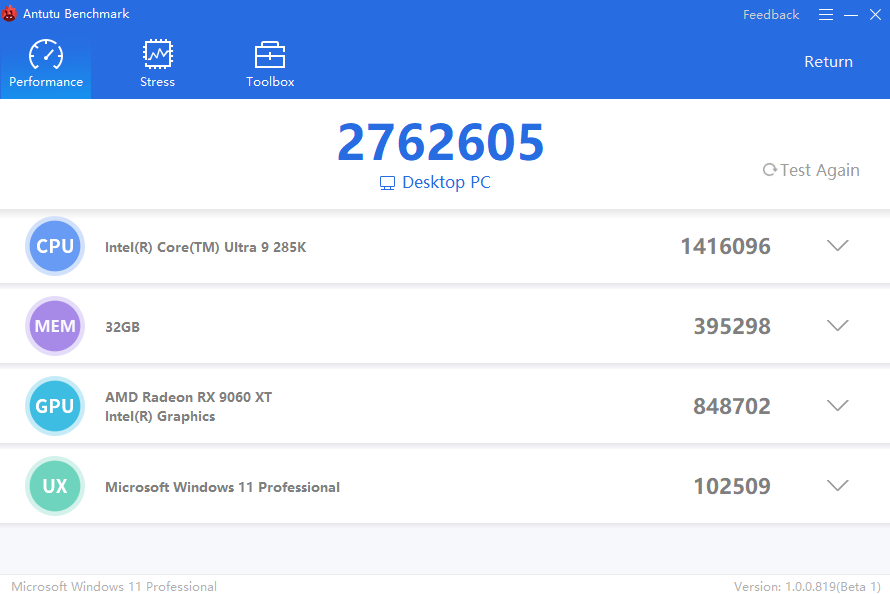
AnTuTu is a benchmarking app used to test and score the overall performance of smartphones and other devices, evaluating components like CPU, GPU, memory, and user experience (UX) through stress tests, helping users compare a phone’s raw power for tasks like gaming and multitasking, though scores should be balanced with real-world usage.
| Benchmark | ASUS TUF RX9060XT 16GB OC | ASUS TUF RTX 5060TI 16GB OC |
| CPU | 1416096 | 1469431 |
| Memory | 395298 | 393243 |
| GPU | 848702 | 1174617 |
| UX | 102509 | 101323 |
Should you buy ASUS Prime RX 9060XT 16G OC?
Purchase Click Here
The ASUS Prime Radeon RX 9060 XT 16GB OC delivers exactly what modern mid-range gamers want: high performance, excellent efficiency, and long-term value. Built on AMD’s RDNA 4 architecture and manufactured on an advanced 4 nm process, the Navi 44 GPU provides a major leap over the RX 7600 XT, offering higher frame rates, better ray-tracing efficiency, and significantly improved power efficiency.
One of its biggest strengths is its 16 GB of GDDR6 VRAM, which gives it a clear advantage in today’s increasingly memory-hungry games. While NVIDIA’s RTX 5060 Ti benefits from faster GDDR7 memory and superior ray-tracing performance, it typically ships with less VRAM, which can become a limitation in modern AAA titles, especially at 1440p with high-resolution textures. In real-world gaming, the RX 9060 XT’s large memory pool, combined with Infinity Cache and AMD’s improved memory management, allows it to remain extremely competitive in rasterized workloads.
The addition of PCIe 5.0 x16 is another major advantage for AMD, giving the RX 9060 XT far more bandwidth than the RTX 5060 Ti and far more than older RX 7600 XT cards, helping eliminate bottlenecks on modern platforms and improving long-term platform compatibility.
ASUS’s Prime OC design further enhances the card with cool, quiet thermals, dual BIOS, and a factory overclock that delivers stable performance out of the box. Compared to the RX 7600 XT, it is a substantial upgrade, and compared to the RTX 5060 Ti, it offers a more future-proof gaming experience for players who prioritize VRAM capacity, longevity, and raster performance over pure ray-tracing dominance.
In the end, while the RTX 5060 Ti remains a strong choice for users focused on ray tracing and NVIDIA’s software ecosystem, the ASUS Prime Radeon RX 9060 XT 16GB OC stands out as the better all-round gaming GPU in its class — offering more memory, better platform support, and stronger long-term value, making it one of the smartest mid-range GPU choices for 1080p and 1440p gamers in 2025.
ASUS Prime RTX 9060XT OC 16GB
669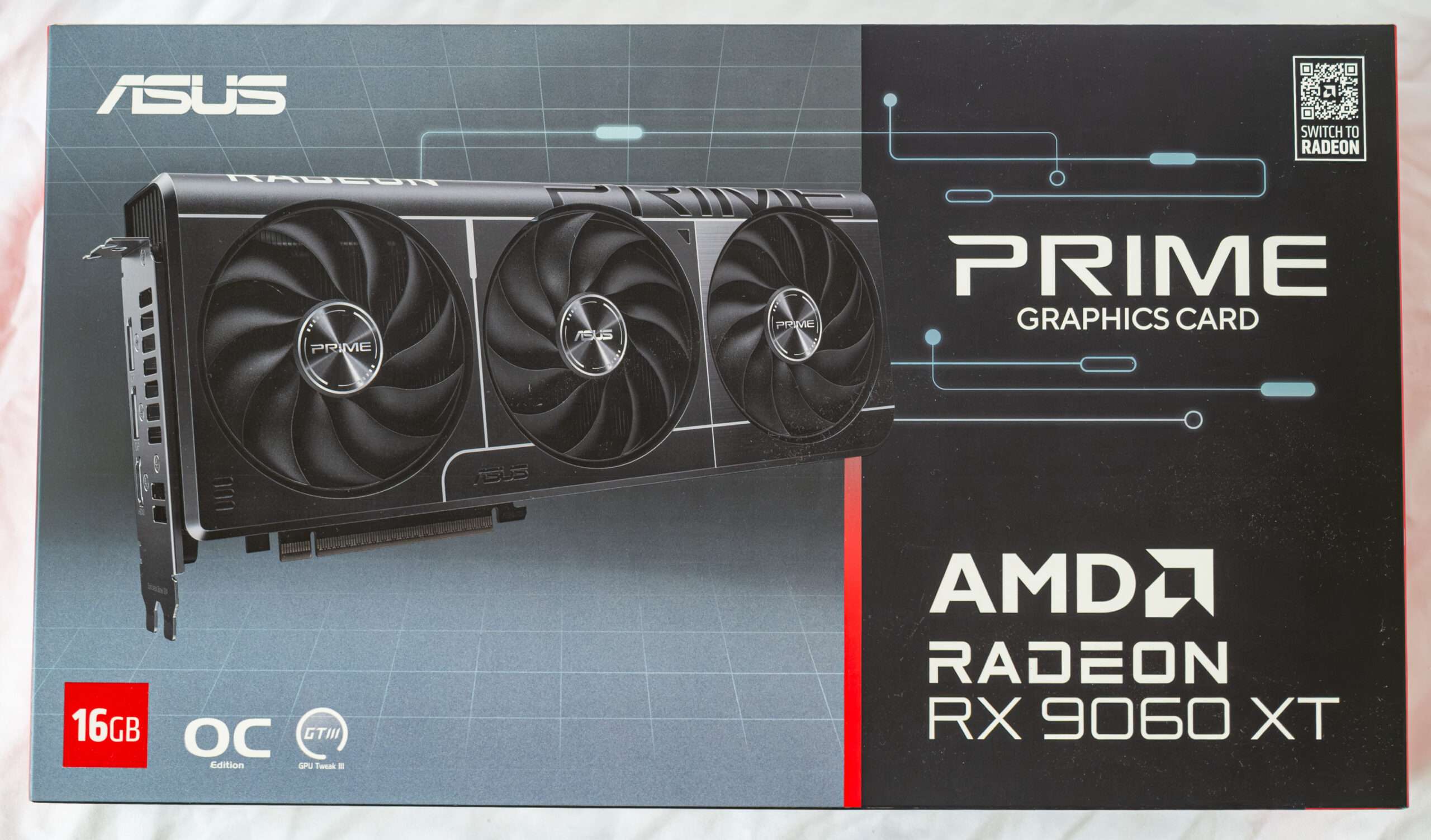
Pros
- Best in class for 1080P & 1440P
- Good Performance with FSR 4
- 8-pin Power Connectors PSU
- PCI-Express 5.0
- 60% faster than RTX 2070 Super
Cons
- Lack of RGB
- DDR6 and not DDR7